An advanced version of BOS 200® designed for tougher petroleum sites with LNAPL, complex hydrocarbon mixtures, or high-mass loading.
How It Works
BOS 200+ is a patented in-situ remediation amendment that expands on the proven BOS 200 platform. It enhances performance at challenging petroleum-contaminated sites through advanced sorption, microbial colonization, and sustained biodegradation.
Mechanism of Action:
- Adsorption: High-purity powdered activated carbon (AC) immediately captures hydrophobic contaminants like LNAPL and BTEX compounds, reducing aqueous-phase concentrations on contact
- Biological Colonization: The AC particle structure allows for deep microbial inoculation and biofilm growth within and off the carbon surface—something liquid or colloidal carbon cannot replicate due to size and pore structure
- Enhanced Biodegradation: A proprietary blend of hydrocarbon-degrading microbes, carbohydrates, amino acids, and both fast and time-release terminal electron acceptors supports immediate and long-term microbial activity
- Long-Term Performance: The system is designed to function under both aerobic and anaerobic conditions and is largely insensitive to groundwater geochemistry (e.g. pH, ORP, salinity)
Performance Results
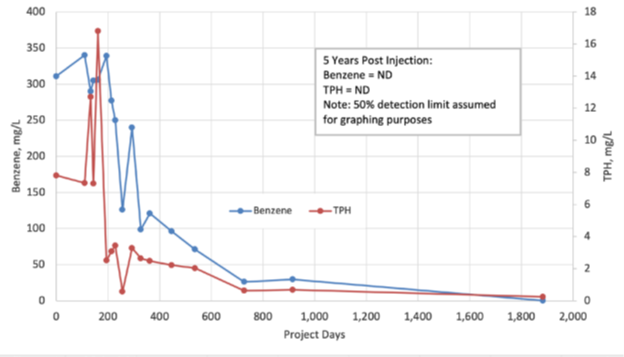
BOS 200+ has demonstrated exceptional contaminant reduction and persistence even under complex conditions.
- LNAPL Mass Reduction: Documented disappearance of measurable product in <6 months
- High-Concentration Site Performance: >95% BTEX and TPH reduction across source and downgradient areas
- Longevity: Active biological performance observed 2–4+ years post-injection, even in anaerobic, nutrient-poor aquifers
Common applications:
- LNAPL source areas and smear zones
- Sites with long-term rebound or MNA failure
- High-concentration PHC plumes
- Regulatory-driven active treatment mandates
- PRB installations to intercept migrating PHC mass
Typical site types:
- Refineries and fuel depots
- Military installations
- Oil and lube blending facilities
- Airports
- Industrial manufacturing and transport terminals
- Coastal or high-groundwater locations with PHC migration
- Military installations
- Airports
Product Comparison
| Feature / Spec | BOS 100® | BOS 200® | BOS 200+® | CAT 100® |
|---|---|---|---|---|
| Target Contaminants | Chlorinated solvents (TCE, PCE, DCE, VC) | Petroleum hydrocarbons (BTEX, TPH, LNAPL) | Complex PHC sites: LNAPL, MTBE, glycols, etc. | CVOCs, DNAPL, mixed chlorinated solvent mass |
| Primary Mechanism | Adsorption + abiotic reductive dechlorination (ZVI) | Adsorption + aerobic biodegradation | Adsorption + enhanced bio (aerobic & anaerobic) | Adsorption + catalytic degradation + engineered bio |
| Activated Carbon Type | Powdered AC with micro-scale ZVI | Powdered activated carbon | Agglomerated ultra-pure AC for microbial colonization | Conductive AC matrix embedded with ZVI |
| Biological Component | None | Native stimulation + nutrient blend | Proprietary microbial consortia + nutrient system | Engineered donors + peptides feeding catalytic process |
| Reductive Capacity | Yes – ZVI-driven | No | No | Yes – Catalytic ZVI (non-stoichiometric) |
| Biological Activity | Limited | Aerobic only | Aerobic + anaerobic | Aerobic + anaerobic |
| Persistence / Longevity | 5–10+ years | 3–5 years | 2–4+ years | 2–4+ years with extended catalytic activity |
| Ideal Use Cases | CVOC plumes, low-perm zones, regulatory-driven sites | BTEX/LNAPL plumes, polishing after excavation | Persistent LNAPL, smear zones, PRBs | DNAPL source zones, high-mass CVOC, mixed plumes |
| Compatible Conditions | Anaerobic required for ZVI activity | Aerobic preferred | Works in aerobic/anaerobic settings | Functions in both aerobic and anaerobic environments |
| Iron Demand / Consumption | Stoichiometric | N/A | N/A | Catalytic – minimal iron depletion |
| Delivery Methods | Direct push, trench, injection wells, PRBs | Direct push, wells, soil mixing | Direct push, wells, PRBs, mixing | Direct push, wells, soil mixing |
| Field Proven? | Yes – 500+ CVOC sites | Yes – widespread PHC remediation | Yes – complex PHC/LNAPL sites | Yes – used in U.S. + Europe at complex DNAPL sites |