
Abstract
The subject facility is an active pipeline and petroleum storage site in the Gulf Coast Region where a leaking aboveground storage tank (AST) created a large dissolved and LNAPL plume. BOS 200+®, a modified version of BOS 200®, was applied over a large area during a 6-month period in 2017. Results to date indicate that LNAPL levels have been eliminated or significantly reduced. In addition, benzene and TPH levels have decreased an average of 96.3% and 97%, respectively. A No Further Action determination has been requested and is pending.
Challenges
The challenges for this project included the following: active petroleum storage, pipelines and sub-surface electrical, shallow groundwater table (western treatment area), and shallow DPT refusal in one area, which required a Pre-Drill injection technique
Objectives
]Elimination of measurable LNAPL.
Approach
1,110 soil samples were collected as part of a large RDC in early 2017. The sample results were used to create an optimized and surgical BOS 200+® design. All samples were analyzed at the RPI Project Support Laboratory at no cost.
Injection specifications:
• 93,000 ft2 Treatment Area
• >1,000 Injection Locations
• 361,000 lbs BOS 200+®
The majority of the injection locations were completed using direct push injection techniques. In one area, shallow refusal was encountered (weathered shale), so the Pre-Drill technique was used to reach the target treatment depth
Results(5 Years Post Application)
LNAPL
• The total number of wells with measurable LNAPL prior to remediation: 15
Post-remediation LNAPL statistics
• No measurable LNAPL: 12
• Sheen: 2
• Measurable LNAPL: 1 (current max LNAPL thickess = 0.02 ft)
Dissolved Total Volatile Petroleum Hydrocarbons
• The average dissolved TPH concentration in the monitoring wells prior to remediation: 20.9 mg/L
• Post-remediation average concentration: 0.38 mg/L (97% reduction)
Post treatment analytical support provided by the RPI Project Support Laboratory at no cost.
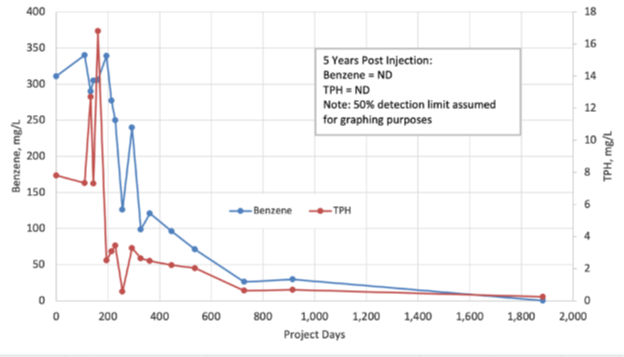
Figure 1. Example of Post Injection Recovery Well Groundwater Data