Challenges and Objective
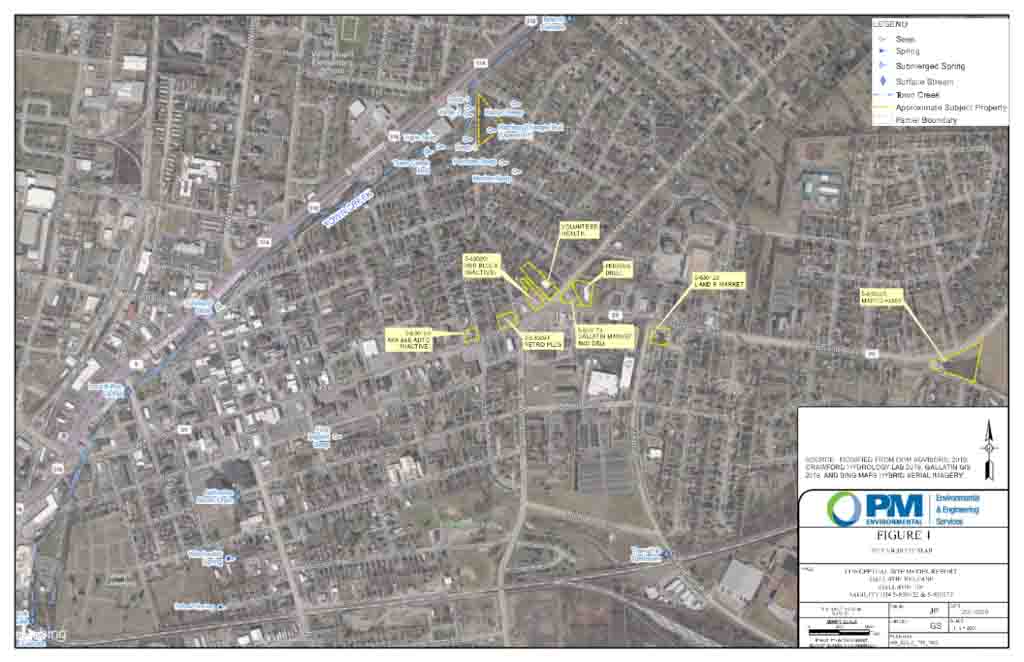
The Tennessee Department of Environment and Conservation’s (TDEC) Division of Underground Storage Tanks partnered with the City of Gallatin on a long-term clean-up effort to remediate petroleum contamination that had been identified seeping from along the eastern bank of Town Creek Greenway. Additional seeps were identified within the residential neighborhood adjacent to Town Creek releasing petroleum impacted groundwater to the surface resulting in significant petroleum odors. The objective of TDEC, its state contractor, and supporting subcontractors was to develop and implement an aggressive fast tracked comprehensive clean-up plan to eliminate impacted groundwater from entering the creek while identifying sources contributing to the contamination.
Approach
The initial phase of work involved conducting a data gap analysis, which encompassed historical research, site reconnaissance, surveying, and testing of underground storage tanks (USTs) and piping systems used for gasoline storage and distribution at five current or former gas facilities located upgradient of the seeps. The outcomes of this analysis, together with remedial design characterization (RDC), informed the development of a comprehensive conceptual site model depicting contaminant distribution within the complex karst geological environment.
The RDC incorporated several elements, including a dye-trace study to delineate groundwater flow paths, surface geophysical investigations to map structural features and potential pathways, two rock core extractions, installation of twenty bedrock wells, downhole geophysical assessments, discrete groundwater sampling of bedrock features, and high-resolution soil and groundwater sampling in suspected primary and secondary source zones.
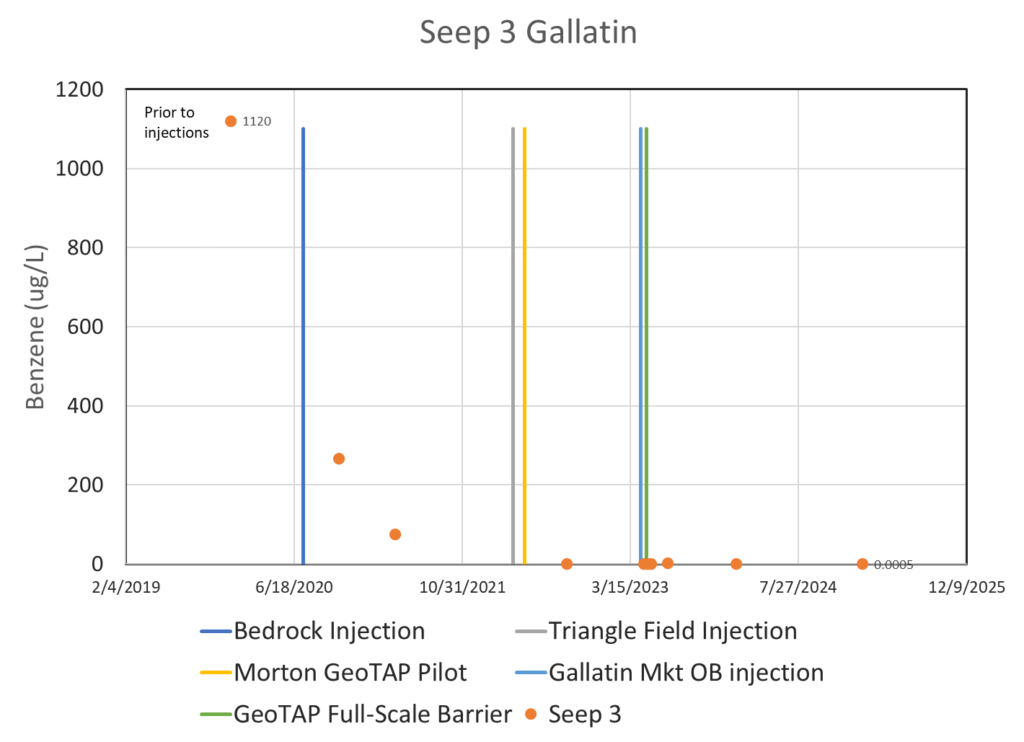
Findings indicated that contaminant migration is primarily occurring through weathered bedrock epikarst systems and shallow competent bedrock features. Shallow overburden groundwater and soil impacts were also detected in a broad field adjacent to the creek. Interim remediation involved injecting BOS 200® into formation areas to curb petroleum migration and facilitate long-term biological treatment. Application of BOS 200® as a slurry targeted both shallow competent bedrock and epikarst features via transects to intercept migrating groundwater, utilizing specialized straddle packer assemblies and high-energy injection pumps and mixing systems for bedrock, and GeoTap drilling and injection techniques for epikarst zones. Additionally, BOS 200® was applied aerially in the large field next to the creek to address secondary sources and establish a treatment curtain for groundwater entering the creek.
Results
The remediation efforts have demonstrated the three (3) primary areas of interest near the Greenway and in the residential neighborhood (creek seeps, triangle field seeps, and residential property seeps) have achieved the clean-up goals.
- LNAPL discharging from the seeps and petroleum odors in the Greenway have been eliminated, the green space has been returned to pre-release conditions
- Dissolved BTEX constituents in groundwater have been reduced to below Federal MCLs in all three areas
The State of Tennessee Department of Environment and Conservation (TDEC) provides ESRI Storymaps to help disseminate and communicate information to the public regarding environmental clean-up projects, one was prepared for this project highlighting the progress and successes realized through the combined efforts of AST and other partner companies involved in the investigative and remediation. The link to this resource is here (TDEC Storymap). Pending the final completion of the necessary abandonment and restoration activities, the project is scheduled for the issuance of a No Further Action (NFA).